Managing a large property comes with a unique set of landscaping challenges. Whether it’s an acreage, rural estate, or an expansive residential lot, maintaining both functionality and visual appeal can quickly become time-consuming and expensive.
For property owners looking to cover large areas, control erosion, or define outdoor spaces, landscape rock offers a highly efficient solution. Unlike organic mulch that requires annual replacement, landscape rock provides long-term coverage with minimal maintenance.
The key to cost-effectiveness lies in choosing the right material, understanding how much you need, and sourcing it at competitive bulk pricing.
Why Landscape Rock Makes Sense for Large Properties
Large properties demand more upkeep than smaller lots. Extensive lawns require regular mowing, garden beds need constant attention, and sloped areas are often prone to erosion.
Landscape rock helps reduce these challenges by offering:
- Lower maintenance: eliminates mowing, trimming, and frequent weeding
- Erosion control: stabilizes soil on slopes and around foundations
- Durability: withstands harsh weather and freeze-thaw cycles
- Long-term value: lasts for years without replacement costs
Understanding Bulk Rock Measurements
Before placing an order, it’s important to understand how landscape rock is measured and priced.
Most decorative rock and gravel are sold by the cubic yard. As a general guideline, one cubic yard will cover about 100 square feet at a depth of three inches. For larger projects, this adds up quickly, a 5,000-square-foot area will require approximately 50 cubic yards.
Some heavier materials, such as river rock, may be sold by weight instead. A cubic yard typically weighs between 2,500 and 3,000 pounds, depending on the type of stone.
Because of the volume involved, delivery becomes a key factor. Ordering in bulk, especially by full truckload, helps reduce the overall cost per unit.
Most Cost-Effective Rock Types
Choosing the right material depends on how and where it will be used. Each option offers a different balance of cost, performance, and appearance.
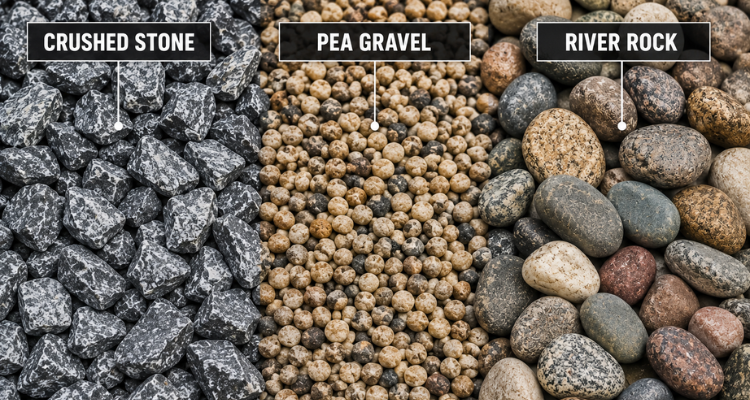
Crushed Stone
One of the most affordable and widely used materials, crushed stone is ideal for functional areas where stability matters.
- Best for: driveways, service roads, drainage areas
- Available in: grey, limestone white, granite blends
- Key advantage: compacts tightly and resists shifting
Pea Gravel
Pea gravel consists of small, smooth stones that are comfortable underfoot and visually appealing.
- Best for: pathways, play areas, garden borders
- Colours: natural earth tones like tan, brown, and grey
- Key advantage: versatile and easy to work with
Recycled Concrete Aggregate
For those focused on budget and sustainability, recycled concrete aggregate is often the most economical choice.
- Best for: driveway bases, laneways, erosion control
- Colour: grey
- Key advantage: lowest cost with reliable performance
River Rock
River rock is a premium material known for its smooth texture and natural look. Due to its higher cost, it’s best used selectively.
- Best for: accent areas, dry creek beds, decorative features
- Colours: mixed tones including grey, brown, cream, and rust
- Key advantage: strong visual appeal
Cost Comparison by Application
Using the right material in the right place is one of the easiest ways to control costs.
- Driveways and parking areas: crushed stone or recycled aggregate offer the best value
- Pathways and walkways: pea gravel provides comfort and flexibility
- Erosion control: larger crushed stone delivers strong stability
- Decorative features: river rock works best when used sparingly
Calculating Volume Requirements
Accurate calculations help avoid unnecessary expenses and delays. The process is straightforward:
- Measure the total area in square feet
- Determine the required depth (2–3 inches for ground cover, 4–6 inches for driveways)
- Multiply square footage by depth, then divide by 27 to convert to cubic yards.
If you’re unsure, most suppliers can help confirm your calculations before ordering.
Reducing Costs Through Smart Purchasing
A few strategic decisions can significantly lower your overall project cost:
- Order full truckloads to reduce delivery cost per yard
- Choose locally sourced materials to avoid transport surcharges
- Combine orders for potential discounts
- Buy during the off-season when demand and pricing, may be lower
- Consider recycled materials for budget-friendly performance
Installation Tips for Large Properties
Proper installation ensures your landscape rock performs well over time. Skipping this step can lead to shifting, sinking, or weed growth.
For best results:
- Clear vegetation and topsoil before installation
- Install landscape fabric to prevent weeds and settling
- Use edging to keep the rock contained
- Apply material in layers for deeper coverage
- Perform occasional maintenance, especially in high-traffic areas
Why Choose Nick’s Landscaping Depot
Large-scale projects require a supplier that understands both materials and logistics. Nick’s Landscaping Depot provides bulk landscape rock at competitive prices, along with delivery services suited for rural and large properties.
Customers also benefit from expert guidance on product selection and volume calculations, helping ensure the project runs smoothly from start to finish.
Conclusion
Cost-effective landscaping for large properties comes down to making smart, informed decisions. Crushed stone and recycled aggregate provide excellent value for functional areas, while pea gravel works well for pathways and recreational spaces. River rock, although more expensive, adds visual impact when used strategically.
By combining the right materials with accurate planning and efficient purchasing, property owners can create a durable, low-maintenance landscape that delivers long-term value. Contact us today to discuss your large property project and request a bulk quote.